|
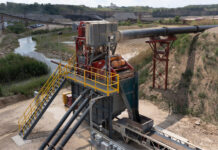
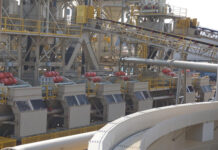
Located between Philadelphia and Allentown, Naceville Materials mines argillite base rock, making three-fourths inch, one-half inch, screenings, three-fourths inch modified and specialty products to state spec, mostly supplying the material for concrete and asphalt producers in the area. The site operates year-round - with three of the four seasons producing rain or snow that create problems with wet material. The modified screen is located at the primary jaw, where it receives the three-fourths inch modified rock from a Simplicity 6 foot x 16 foot three-deck screen, which scalps material from the jaw’s grizzly feeder. The modified screen separates the modified rock into the operation’s three-fouths inch, one-half inch and screenings products.
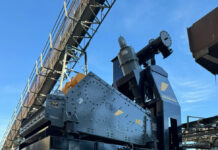
“The 7 foot x 16 foot screen has a flat, dual-deck, polyurethane top deck,” said Grove. “We altered it to take on the dual decks to help alleviate the single deck from overloading and blinding. The dual decks are separated by about six inches but make the same size product. The bottom deck currently has a polyurethane step-deck.”
Naceville’s former quarry foreman, Darren Landis (now a regional supervisor for H&K), had worked with its screen dealer, Kemper Equipment of Honey Brooke, PA, to try all of these screen media modifications, and more, in his attempts to solve the modified screen’s ongoing blinding and plugging problems, Grove explained.
Initially, Kemper and Landis attempted to solve the screen’s blinding issues by installing a splitter box, which alleviated the amount of modified stone going to the screen. “The splitter box allows us to control the amount of material going to the screen, and we use it based on the moisture content at any given time,” said Grove. “Moisture makes the material stick to the screen. When it’s raining, we have to shut down the screen completely. If the material has any moisture at all, we’re still shutting down the screen three or four times a day to clean it.”
With the screen still experiencing blinding, Kemper and Landis installed step-deck screens on both decks, but the screen media change did not solve the problem. The dealer and quarry foreman then tried the dual top deck configuration, essentially creating two separate decks out of the top deck. They also tried different screen opening sizes on the top layer of the dual deck to help split the screening duties of both layers more evenly - all to no avail.
“Then we got a call out of the blue,” recalled Grove, who at the time had been the quarry’s maintenance foreman. “Keith (Meitzler) from Kemper wanted to bring in Brad Rice, his territory manager from Major Wire, to check out the setup and see what they could do.”
Major Wire Industries, based in Montreal, Canada, had been looking for test sites to try its new flat-deck, Flex-Mat® screen solution. Called Flex-Thane™, this screen media solution combines the efficiency and performance of Major Wire’s proven Flex-Mat technology with the easy installation of polyurethane and rubber panels to virtually eliminate blinding and pegging problems on flat-surface screen decks. Flex-Thane’s independently vibrating wires, bonded in place with the distinctive lime-green polyurethane strips, also provide more open area for far greater throughput, higher production and better efficiency than polyurethane and rubber screens in hard-to-screen applications. Its modular panels install easily on most common flat-surface screen decks, similar to traditional polyurethane and rubber panels.
“Darren was ready to try anything to alleviate the blinding,” said Grove. “So he agreed to put in some test panels of the Flex-Thane. Kemper ordered them, and after the panels were custom-made, they arrived in May 2007. By that time, Darren had become our regional supervisor and I had been promoted to quarry foreman, so I installed the panels on the bottom section of the dual top deck.”
While the modified screen’s decks were still primarily running with polyurethane screen media, Grove said he immediately noticed a difference with the Flex-Thane panels. “Where the other polyurethane panels were blinded, the Flex-Thane panels ran clean,” he said.
Between May 31 and December 31, 2007, Naceville Materials ran more than 50,000 tons across the Flex-Thane test panels. “There’s been no wear that I can see on these panels,” Grove said. “I’ve wanted to complete the decks, and install more Flex-Thane throughout the screen, but we’ve held off because we’re possibly going to upgrade to a larger modified screen at the primary - an 8 foot x 20 foot Simplicity screen, from another H&K location, that has crown bars and is using Flex-Mat already. But if we were keeping this screen here, this would be the way to go.”
|
|
Because it is manufactured in modular panels, with a variety of locking systems to fit virtually any flat-surface polyurethane or rubber screen deck, Flex-Thane is easy to install. The product is available in 1 foot x 1 foot and 1 foot x 4 foot standard panel sizes. It can also be custom made in 1 foot x 2 foot, 1 foot x 3 foot and mixed panel dimension sizes.
According to Grove, when screening “raw” material from the point of the shot, the producer will experience more problems with blinding due to the material’s lack of refinement. If the material is wet, the issue is further compounded. The crushing process not only dries the material, but it also makes it a more desirable shape for screening, so it does not plug the screen. Therefore, even in dry conditions, a modified screen at the primary, handling raw material from the shot, is going to need a screen media that resists blinding.
“We definitely solved the blinding problem with the Flex-Thane panels,” said Grove. “It seems to be the best product out there for blinding on flat-deck screens. In fact, the Flex-Mat technology as a whole seems to be the best way to go,” he added.
|