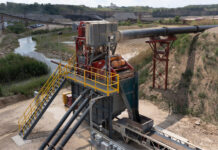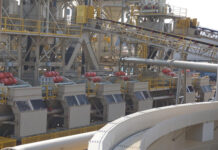
Have you ever wondered what it takes to get a quarry up and running from scratch? Over the last few years, one North Carolina man and his team have found out. More importantly, Stephen C. Holland, owner and operator of Shelter Creek Quarry in Burgaw, NC has proven that it can be done.  | Material from the top deck of the 4 deck screen drops into this surge hopper before being conveyed under a magnet and on for further processing. |
While most companies engage attorneys to traverse the myriad regulations, studies, permits and other forms of red tape involved, Holland opened the state’s first quarry operation that was managed start to finish by the owner. That was in April of 2009. Kicking Around the Idea Over more than 20 years, Holland, a businessman and restaurateur, purchased 560 acres of land previously owned by Ideal Cement Co. He accomplished that in eight separate transactions. He completed the purchase of the mining site in 2000 and built a game preserve on the land for hunting and fishing.  | Stephen Holland is the first quarry owner in NC to completely manage the tedious process of getting an operation functional. |
Although Ideal had located soft rock on the site, that company was unable to obtain federal clearance for necessary renovations, which included straightening the creek itself. Ideal ultimately established chose another location, building its plant in nearby Castle Hayne, NC. Holland also located rock at the site and at one time, entertained some interest in the property from Martin Marietta in 2002. He said that the deal didn’t materialize so he picked up the pursuit of creating his own quarry again, a couple of years later. At that time, he hired an engineer, a geologist and a driller to perform core sampling. “I didn’t think it would go this far,” he admits, “but they found lots of stuff when they were drilling, so I decided to take a chance.” Studies, Paperwork and Permits Holland said that he had made an excellent choice when he selected his blasting and mining engineer, Stephen Dorenda. At the time, Dorenda had 32 years of experience and he had worked with several plants in the past. More importantly, he had worked for Ideal previously so he knew there was rock on the site. Together, the men hoped to establish 252 acres in mineable property, so in 2005, they sought a Pender County permit.
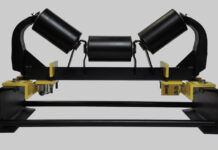
 | The TEREX Cedar Rapids MVP 450 secondary crusher puts the finishing touches on oversized material coming off the 4 deck screen. |
|  | Another view of the TEREX CR MVP 450 shows the easy access that crews have to the crusher. |
|
Their permit application specified that Holland would establish excavation and mining on 252 acres of the 380 acre site, with the 128 acres of protected wetlands on the site, not to be disturbed. They planned to use open pit mining techniques with portable equipment. They would remove and store the overburden for each one of the four planned phases during the excavation of marl and limestone. Their initial mining cut into each phase would use explosives for the preliminary pit opening. The application stated that Holland would use excavators for additional work, if possible. They planned to have their primary crushing within the pit, with the material moved by conveyor to a separate finishing plant. Initially, their planning indicated that each mining phase would run about 10 years. The entire operation was to be wrapped up in four to five decades with reclamation, including inundation, of each phase to be completed when mining ceases in those areas. Additionally, they plan to establish a fish habitat on the phase two site. Ultimately, they are hoping that the land will become a residential development, with recreational boating, fishing and other water sports. That is in addition to a wildlife habitat and a water supply storage facility. With the county’s approval, Holland proceeded with three years of state, federal and wetlands studies. By 2007, reams of paperwork remained in his future or so he thought. In a stroke of luck, an official in the state capital realized that there were 72 wetlands free acres on the site that could be permitted in a month’s time. “Because there was an estimated $300 million worth of hard rock on those 72 acres, not including other marketable materials such as sand, he saw that it was feasible,” Holland says. “We got the permit within 30 days. That was in October 2007.” He adds that the process typically takes three to five years with an investment of $20 million. Shelter Creek’s permitting costs ran about $700,000; delineation came in at $1.2 million.  | From left: Stephen Dorenda, engineer, Stephen C. Holland, owner and Mark Greenway, foreman are the key players at Shelter Creek Quarry in Burgaw, NC. |
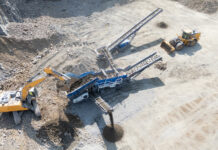
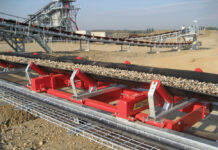
|  | The compact layout of Shelter Creek’s crushing an processing plant demonstrates how efficiently the footprint of a new plant can be planned. |
|
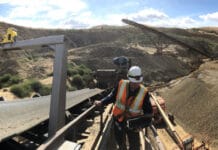
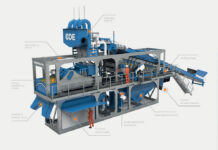
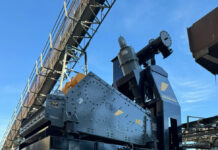
Under Construction Interstate Equipment Company www.interstateco.com of Cary, NC worked with Stephen Holland and Stephen Dorenda to make the proper plant equipment selection. IEC also supplied the primary and secondary crushing equipment as well as the sand washing equipment. Steel Systems (www.steelsystems.com) worked with all parties involved to optimize the plant layout while meeting the production criteria. Steel Systems also supplied the engineering and manufacturing of all of the conveyors, bins, hoppers and structural support steel. Holland says that the operation was planned and built with efficiency in mind. He noted that they market everything that they mine. “Most mines have their water just run off and/or into streams, but here it is recycled and put back on land,” Holland says. “The emphasis is on environmental safety and that aided us in getting the permit.” Excess water is handled by a system designed by Dorenda. Dorenda’s plan involves pumping water from the quarry to a U-shaped pond and then into a teardrop shaped lake. Three outlets go into a level spreader, also created by Dorenda, where the water is aerated. From there, it migrates into the wetlands areas. “This water is tested daily and has a pH of 7.5,” Holland adds. “That’s cleaner than tap water.” Holland says state officials were so impressed with Dorenda’s innovation that they now recommend it to other developers of new quarries. Energy efficiency also is important at Shelter Creek. Holland states that while some plants spend $24,000 monthly on electricity, Shelter Creek is averaging an astoundingly meager $4000. Even with this low power consumption rate, they can process up to 1000-tons of rock per hour. This is partially attributable to using two, rather than three crushers (Cedar Rapids jaw crusher and CR 450 MVP). They also incorporated oversized scalping and screening decks, which lend compactness and portability. According to Holland, Shelter Creek operates one of the few four deck screens in the state.  | The TEREX Cedar Rapids primary jaw crusher sees plenty of action on a normal work day. |
|  | Shelter Creek's 4 deck vibratory screen gives them capacity for optimum production. |
|
Up and Running By April 2009, the quarry was mining on 15 acres of the site and they were producing much more material than originally estimated. Holland says that the mine employs 10 currently, and their trucking is outsourced to local firms when buyers require transportation services. He says that Shelter Creek is the state’s only operation that manufactures eight different products including ABC, riprap, sand and calcium and lime for agricultural feed. Holland says an additional 180 acres eventually could be mined, but permitting expenses prohibit that at present. He said that eventually, he may take on partners or investors or even sell the operation. However, given Holland’s uncanny ability to do it himself, he may be in the quarry business for years to come. Jenan Jones Benson is a freelance writer based in Greensboro, NC. To comment on this story or for additional details click on the related button above. |