|
by Annette Deming
Increased size of mining, mineral and aggregates processing equipment requires precise machining; mistakes can drive up costs by six figures Think big. Transformers big. Because when it comes to satiating the world’s inexhaustible demand for infrastructure, small won’t cut it. More than ever, processors within the mining, mineral and aggregates industries are taking advantage of economies of scale by equipping their plants with mega-sized grinding tables, roll crushers, kilns and material handling systems-all in an effort to make big money off big demand.
 |
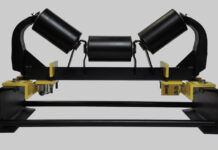
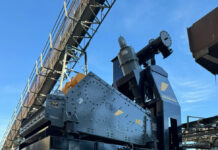
The cross drive’s gear assembly is housed within a sealed conveyor drive roller protected from the environment and is connected directly to an external motor eliminating the chain/sprocket or belt/pulley used in conventional systems. |
However, the gargantuan size of the respective parts (26-foot diameter gears, for example) of these machines does not necessarily widen the margin of error in their manufacture. If anything, miscastings or machining mistakes get magnified. Attention to detail like that of a Swiss watchmaker becomes necessary to ensure that these parts hold up under the extremely heavy demands of non-stop operation.
“We make castings up to 100 tons, and at that size, the experience and expertise of the machining provider becomes very important,” says Joe Simko, president of Hodge Foundry in Greenville, PA. “You might have a perfect casting, but if there is a mistake made during the machining process, then obviously it could be extremely costly — well north of $100,000.”
Feeding the beast For those mining, minerals and cement producers opting to “supersize” their processing equipment, the payoffs look to be enormous. Look no further than the third-world’s voracious appetite for infrastructure to account for the unrelenting call for cement, iron ore, other minerals and coal.
According to Cleveland-based market research firm, The Freedonia Group, Inc., worldwide demand for cement is expected to rise at an annual rate of 4.8 percent through 2008. China accounts for the lion’s share, sequestering 44 percent of the global supply, but a robust construction outlook in other Asian countries, Latin America and Eastern Europe up the projected demand for cement to 2.8 billion metric tons by 2010, representing a value topping $200 billion.
A June-2005 report by AME Research predicted that global iron ore consumption will grow to more than 1.9 billion tons by 2009. Additionally, mining claims for minerals have risen in 12 western states by an average of 81 percent since 2003, as per an October-2007 report by Washington-based Environmental Working Group.
“Some of our recent major projects are for gold mines in Australia, but just about all metals are seeing an up-tick in demand,” says Hodge Foundry’s Simko. “Even the naysayers, who in the past said mining is cyclical, are admitting that this is an absolute ‘super cycle.’ Copper, along with nickel, platinum and molybdenum, are all leading the charge. So with this amount of demand out there, you can see why our business is so strong.”
 |
The cross drive’s gear assembly is housed within a sealed conveyor drive roller protected from the environment and is connected directly to an external motor eliminating the chain/sprocket or belt/pulley used in conventional systems. |
Founded in 1876, yet continuously modernized (as recently as 2006), Greenville, PA-based Hodge Foundry is an international specialty-engineering foundry that manufactures high quality complex gray and ductile iron castings that range in size from 3,000 to 200,000 pounds.
An ISO 9001 certified manufacturing facility, Hodge specializes in equipment applications for cement and ore grinding such as bearing bases, caps, gears, mill heads and trunnions, and other component castings for SAG and ball mills. Hodge is also one of two domestic foundries that make large hubs and bed-frames for wind turbines. The company casts its mammoth-sized ductile iron gear blanks-some of which are rated for service up to 3,750 horsepower, to near final shape, which, when compared to fabricated welded steel gears, translates into a substantial cost savings and shorter lead times.
Big Castings Call for Big Machining To meet final specs’, ductile iron gear blanks and other similar parts still need machining. However, very few fabricators have the facilities to support castings attaining massive dimensions like 20-feet x 40-feet x 7-feet — bigger than a locomotive.
“We recently participated in a major project in Saint Genevieve, MO, that called for a large grinding table weighing 60 tons,” recalls Simko. “Since we are constantly looking for machine shops to partner with to machine large castings, we were glad to learn that BVI was willing to finish this project. That’s their niche, the really big stuff.”
BVI Precision Materials, located in a 300,000 square foot facility in Allentown, Pennsylvania, was founded in the former Fuller plant originally founded in 1906. The company now offers a manufacturing capability that includes machinery and equipment for the infrastructure, power generation, mining, and cement industrial sectors. ASME certified in both pressure vessel and piping, the company provides highly engineered, complete turnkey solutions that encompass precision CNC machining and fabricating of gears, condensers, heat exchangers, kilns, mills, screens, crushers, dredges, conveyers, classifiers, cyclones, ducting and transition risers.
With an inhouse capability to lift Godzilla-sized machines weighing 150 tons, BVI is unique in its ability to completely equip large-scale plants, starting from design and continuing all the way through fabrication, testing, shipping and installation. “BVI is one of possibly three fabricators in North America that can handle castings that large,” comments Simko. “But the main reason we do business with them is the experience of their management and the expertise of their workers. With the large castings we manufacture, any mistakes get to be pretty costly.”
“Location also factors into our choice,” continues Simko. “The logistics of moving multi-ton machinery can be daunting not only because of the weight, but the physical size — so we opt for a fabricator who is conveniently located in eastern Pennsylvania and can readily transfer the finished product to a port.”
No small consideration, in light of the inexorable demand for modern, colossal-scale processing plants in both hemispheres. While developing countries are anxious to industrialize themselves with “greenfield” projects, the western world rushes to amplify output by retrofitting older factories with new machines. Appropriately sized equipment can’t arrive fast enough.
The Big picture for the Future The exigency of erecting new infrastructure throughout the world shows no let-up. This trend will continue to justify the urgency of mining operators and mineral, ore and cement processors to “Mac-mansionize” their capabilities to provide prodigious volumes of product. With higher demand comes higher prices and higher profit. “With the price of gold rising so rapidly, deposits that might not have been economically mined could become much more attractive,” said Dusty Horwitt, a public lands analyst at Environmental Working Group, in an Oct. 15, 2007 story that appeared in the Los Angeles Times.
“Global copper inventories have recently dropped to just one week,” adds Hodge Foundry’s Simko. “We’re running at unprecedented growth just to keep up with the demand for our products, and the growth in our industry is expected to continue for years and years. Working in conjunction with companies like BVI, who did a very nice job on the recent grinding table project, we can at least help mining and aggregates companies to cash in on this unrelenting demand.”
To comment on this story or for additional details click on the related button above. |